No products added!
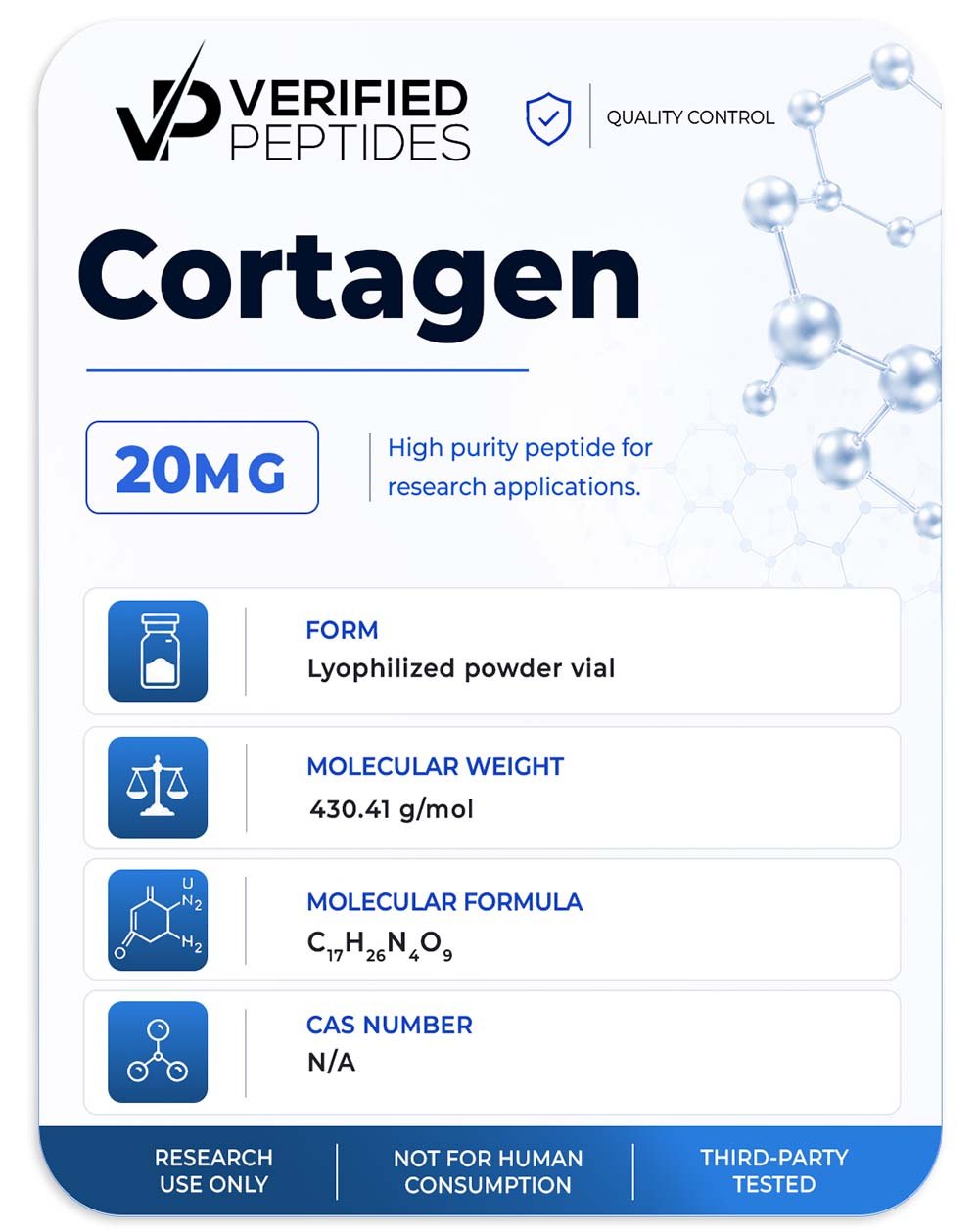
Cortagen Peptide (20MG)
Original price was: $55.00.$33.00Current price is: $33.00.
Cortagen Peptide Information (Khavinson peptide)
FORM |
Powder(lyophilized) |
|---|---|
CAS NUMBER |
N/A |
OTHER NAMES |
|
WEIGHT |
20mg |
SEQUENCE |
Ala-Glu-Asp-Pro
|
Molecular Weight |
430.4 g/mol |
Terms |
Subject to our Terms and Conditions. This material is sold for laboratory research use only. Not for human consumption, animal, or medical use. |
Why isn’t there more information on the Cortagen peptide?
Due to the legal landscape of peptides and research products, providing information that may imply anything beyond laboratory research use is a legal liability. We’re an expert biotechnology company that provides high quality peptides and products for purchase to advance scientific research in this field.
- Order in the next to get it by August 31, 2026
- Real Time 94 Visitors Right Now
- Spend $500.00 to get Free Shipping
Description
Cortagen Peptide
Cortagen Peptide is a synthetic short-chain peptide identified by the amino-acid sequence Ala-Glu-Asp-Pro (AEDP). It belongs to the group of short peptide bioregulators associated with research into tissue-specific biological signaling, gene expression, cellular regulation and molecular interactions.
Cortagen has attracted scientific interest because of its relationship to peptide research involving the cerebral cortex and other biological systems. Published experimental work has examined Cortagen in models of gene-expression regulation, tissue responses and cellular biology, making it a useful compound for researchers investigating the behavior and potential biological significance of short peptides.
At Peptanovia, Cortagen Peptide is positioned as a research-grade laboratory material for qualified researchers, biotechnology organizations, academic laboratories and other scientific institutions conducting legitimate peptide research.
Researchers can explore additional research materials through the Peptanovia homepage.
What Is Cortagen Peptide?
Cortagen is a synthetic tetrapeptide composed of four amino acids:
Ala-Glu-Asp-Pro (AEDP)
The compound is associated with the Khavinson tradition of short peptide bioregulator research and has been investigated as a synthetic peptide derived from studies of natural peptide preparations associated with brain cortex tissue. A PubMed-indexed study specifically describes Cortagen as a synthetic tetrapeptide obtained through directed synthesis based on amino-acid analysis of a natural brain-cortex peptide preparation.
Its short sequence makes Cortagen particularly interesting for researchers studying how small peptides can interact with biological systems and potentially influence cellular and molecular processes.
Cortagen is sometimes described in research literature as a cerebral-cortex-associated peptide bioregulator. However, researchers should distinguish between proposed biological mechanisms, experimental observations and clinically established effects.
Cortagen Peptide Research
Research surrounding Cortagen has explored several scientific areas, including tissue-specific peptide effects and changes in gene expression.
One PubMed-indexed study investigated the effects of Cortagen on gene expression in mouse heart tissue using microarray analysis. The research examined whether administration of the tetrapeptide was associated with changes in gene-expression patterns, illustrating the broader interest in short peptides as experimental tools for studying molecular regulation.
Earlier research on short peptide bioregulators also examined tissue-specific effects of Cortagen and related peptides in organotypic culture models. In that work, Cortagen was studied in relation to explants from rat brain cortex and subcortical structures.
These studies provide a scientific foundation for investigating Cortagen as a research compound without requiring unsupported claims about human therapeutic outcomes.
Cortagen Peptide Applications in Research
Cortagen can be relevant to multiple areas of experimental peptide science.
Molecular Biology Research
The small size and defined sequence of Cortagen make it suitable for experimental research examining short-peptide interactions with cellular and molecular systems.
Researchers can investigate how a defined tetrapeptide behaves under controlled laboratory conditions and compare its properties with other short-chain peptides.
Gene Expression Research
Gene-expression research is one of the documented areas associated with Cortagen.
Researchers have used microarray-based approaches to investigate changes in gene-expression patterns following experimental exposure to Cortagen. Such work can help researchers explore potential molecular pathways associated with short peptide bioregulators.
Tissue-Specific Peptide Research
Cortagen has historically been investigated within the broader concept of tissue-specific peptide regulation.
Research involving Cortagen and related peptides has examined responses in different tissue-derived experimental models, contributing to interest in how short peptide sequences may interact with particular biological systems.
Cellular Regulation Studies
Short peptide bioregulators remain an area of investigation in cellular biology. Research has proposed that certain short peptides can influence processes involving gene expression, differentiation and cellular regulation.
A broader review of peptide regulation of cell differentiation discusses several short peptides and their proposed relationships with signaling pathways involved in cellular differentiation.
Peptide Structure and Function Research
Because Cortagen consists of only four amino acids, it provides a compact molecular system for studying the relationship between peptide sequence and biological activity.
Researchers can compare Cortagen with other short peptides to investigate how differences in amino-acid composition influence molecular behavior and experimental responses.
Cortagen Peptide and Brain Research
Cortagen has particular historical relevance to research involving brain and cerebral-cortex peptide systems.
Experimental literature has investigated Cortagen in connection with brain-derived peptide preparations and tissue-specific responses. Research has also examined Cortagen in experimental models involving neurological and ischemic conditions.
However, these findings should be interpreted within their experimental context. Laboratory and animal research does not establish that Cortagen is an approved treatment for neurological disorders or other human diseases.
For researchers, the more useful distinction is between what has been experimentally investigated and what has been clinically demonstrated.
Cortagen Peptide for Laboratory Research
Research laboratories working with Cortagen may require detailed information before incorporating the peptide into an experimental workflow.
Important product information can include:
- Peptide name
- Amino-acid sequence
- Molecular weight
- Purity specification
- Physical presentation
- Batch or lot number
- Analytical testing
- HPLC information
- Mass spectrometry information
- Certificate of Analysis
- Storage requirements
- Packaging specifications
- Research-use documentation
These details allow researchers to evaluate whether a particular batch meets the requirements of their project.
Research Grade Cortagen Peptide
Quality and analytical transparency are particularly important when working with short research peptides.
A research-grade material should be accompanied by appropriate product specifications so that laboratories can identify the compound and evaluate its analytical characteristics.
Researchers may consider:
Identity: Confirming that the supplied material corresponds to the intended AEDP peptide.
Purity: Reviewing the stated purity specification and available analytical data.
Molecular characterization: Using appropriate analytical techniques to verify peptide identity.
Batch traceability: Maintaining lot-specific records throughout the research process.
Storage: Following the storage conditions specified for the supplied material.
Documentation: Retaining the relevant Certificate of Analysis and product documentation for experimental records.
These considerations become even more important when research projects require reproducibility across multiple batches.
Cortagen Peptide Bulk Research Supply
For laboratories conducting extended research programs, bulk peptide supply can simplify procurement and help researchers maintain continuity between experimental runs.
Bulk Cortagen requirements may be relevant to:
- University research laboratories
- Biotechnology companies
- Pharmaceutical R&D organizations
- Contract research organizations
- Molecular biology laboratories
- Peptide chemistry laboratories
- Academic research teams
- Analytical laboratories
- Preclinical research groups
Before purchasing larger quantities, researchers should establish their required purity, quantity, packaging and analytical documentation specifications.
Why Researchers Choose Defined Short Peptides
Short synthetic peptides provide researchers with highly defined molecular sequences that can be evaluated under controlled experimental conditions.
Unlike complex biological extracts containing multiple peptide species, a defined synthetic peptide can provide a more controlled starting material for structure-function research.
Cortagen’s four-residue AEDP sequence makes it particularly interesting for comparative studies involving other short peptide bioregulators.
Researchers can investigate questions surrounding:
- Peptide sequence
- Molecular structure
- Cellular interactions
- Gene-expression patterns
- Tissue-specific responses
- Peptide stability
- Structure-function relationships
- Comparative peptide activity
Cortagen and Peptide Bioregulator Research
Cortagen is part of a wider research field involving short peptides sometimes referred to as peptide bioregulators.
Research in this area has examined whether small peptide sequences can interact with molecular targets, influence cellular signaling and participate in mechanisms associated with gene expression and differentiation.
A PubMed-indexed review describes research into short peptides and their proposed roles in regulating pathways associated with cell differentiation and gene expression.
The field remains scientifically active, but individual peptides should be evaluated based on their own experimental evidence rather than assuming that findings from one peptide automatically apply to another.
Cortagen Peptide Product Considerations
When evaluating a Cortagen research product, researchers should consider more than the product name or advertised quantity.
A professional purchasing evaluation may include:
Peptide identity: Is the material clearly identified as AEDP?
Purity: Is the stated purity supported by appropriate analytical documentation?
Batch information: Is the product traceable to a specific lot?
Analytical testing: Are appropriate analytical results available?
Storage: Are storage requirements clearly provided?
Packaging: Is the material packaged appropriately for research use?
Documentation: Is relevant product documentation supplied with the research material?
These factors can contribute to better experimental consistency and more reliable laboratory records.
Who Can Use Cortagen Research Material?
Cortagen may be of interest to qualified researchers working in peptide science, molecular biology, cellular biology, biotechnology and related scientific disciplines.
Potential research environments include:
- Academic institutions
- University laboratories
- Biotechnology companies
- Pharmaceutical R&D laboratories
- Contract research organizations
- Independent scientific laboratories
- Peptide chemistry facilities
- Molecular biology research groups
- Analytical laboratories
The suitability of the compound should always be determined by the qualified research team responsible for the experimental protocol.
Research Use Only
Cortagen Peptide should be represented as a research-use material rather than as an approved medicine, dietary supplement or established treatment.
Although published studies have investigated Cortagen in experimental models, these findings do not establish that the peptide is clinically effective for treating neurological disorders, aging, cognitive conditions or other diseases in humans.
This page is intended to provide scientific and product information for legitimate research applications. Researchers should follow applicable regulations, institutional requirements, laboratory safety practices and the documentation provided with the specific product.
Order Cortagen Peptide for Research
Cortagen Peptide offers researchers a defined four-amino-acid sequence for investigating short-peptide biology, molecular regulation and tissue-associated peptide research.
With its Ala-Glu-Asp-Pro (AEDP) sequence and documented history in experimental peptide research, Cortagen provides an interesting model for laboratories investigating the relationship between peptide structure and biological processes.
For researchers sourcing Cortagen for legitimate laboratory work, product identity, purity, analytical documentation and batch specifications should be reviewed carefully before purchase.
Explore additional research peptide products through the Peptanovia homepage.
Related products
-
Price Original price was: $55.00.$33.00Current price is: $33.00.
-
Price Original price was: $55.00.$33.00Current price is: $33.00.
-
Price Original price was: $60.00.$36.00Current price is: $36.00.
-
Price Original price was: $55.00.$33.00Current price is: $33.00.
Reviews
There are no reviews yet.