No products added!
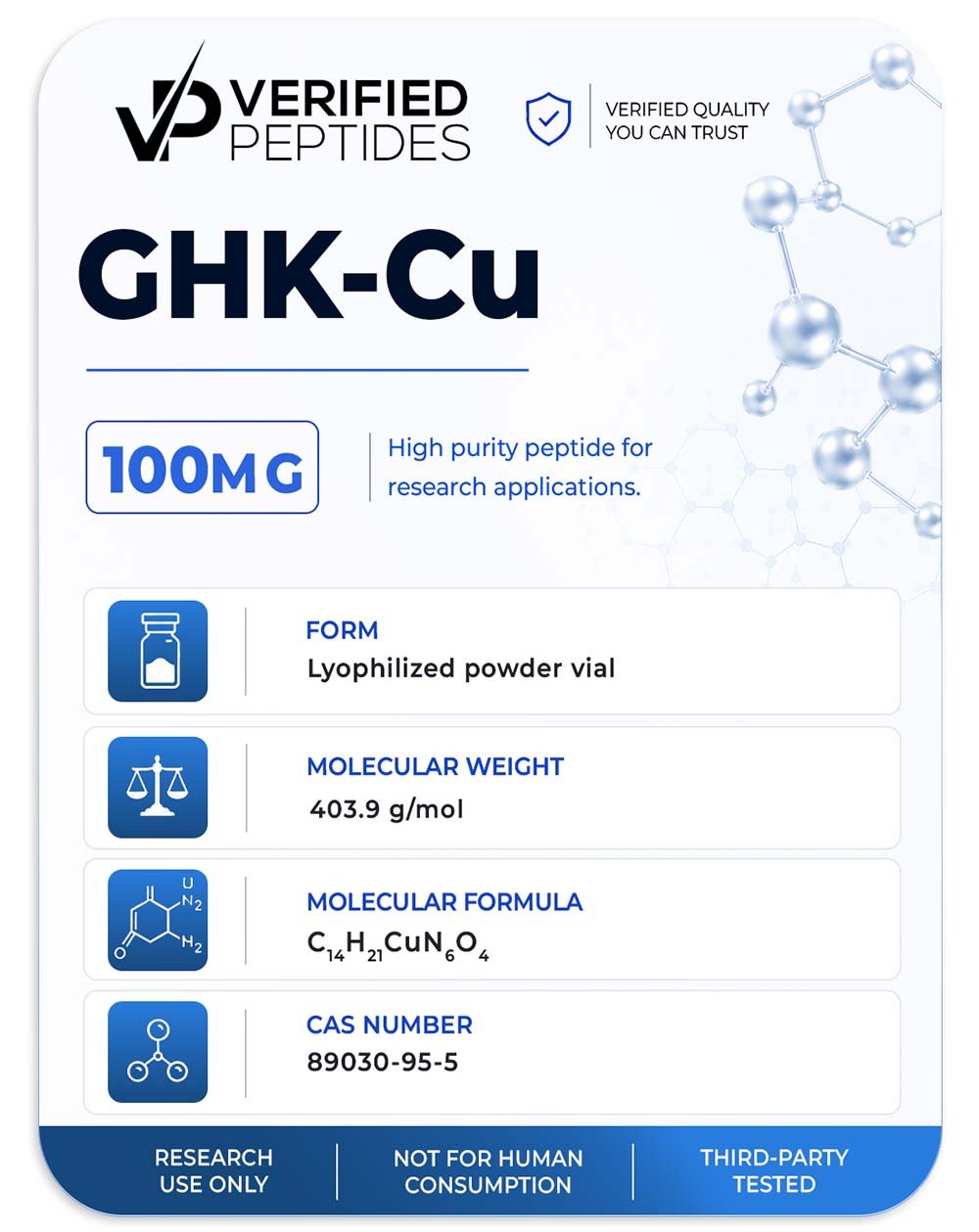
GHK-Cu Copper Peptide (100MG)
Original price was: $49.99.$30.00Current price is: $30.00.
GHK-Cu Peptide Information
FORM |
Powder (lyophilized) |
|---|---|
CAS NUMBER |
89030-95-5 |
OTHER NAMES |
Copper peptide, GHK, Tripeptide, ghkcu |
WEIGHT |
100mg |
SEQUENCE |
Gly-His-Lys(Cu2+) |
Molecular Weight |
748.346 g/mol |
Terms |
Subject to our Terms and Conditions. This material is sold for laboratory research use only. Not for human consumption, animal, or medical use. |
Why isn’t there more information on GHK-CU Peptides?
Due to the legal landscape of peptides and research products, providing information that may imply anything beyond laboratory research use is a legal liability. We’re an expert biotechnology company that provides high quality peptides and products for purchase to advance scientific research in this field.
- Order in the next to get it by October 16, 2026
- Real Time 234 Visitors Right Now
- Spend $500.00 to get Free Shipping
Description
GHK-Cu Copper Peptide 100MG
GHK-Cu Copper Peptide is a naturally occurring copper-binding peptide complex that has become an important subject of research across peptide chemistry, skin biology, extracellular-matrix research, wound-healing studies and cosmetic formulation science.
The compound consists of the naturally occurring tripeptide glycyl-L-histidyl-L-lysine (GHK) associated with copper(II), creating the copper-peptide complex commonly referred to as GHK-Cu or copper tripeptide.
Its combination of a biologically relevant tripeptide sequence and copper-binding properties makes GHK-Cu particularly interesting for researchers studying peptide-metal interactions and biological signaling.
At Peptanovia, GHK-Cu Copper Peptide 100MG is positioned as a research-grade material for qualified laboratories, peptide researchers, cosmetic formulation scientists, biotechnology organizations and other legitimate scientific research applications.
For additional research peptide products, explore the Peptanovia homepage.
What Is GHK-Cu Copper Peptide?
GHK-Cu is a copper complex formed from the tripeptide glycyl-L-histidyl-L-lysine and copper(II).
GHK itself is a small naturally occurring peptide that has been investigated extensively in biological and cosmetic research. Its ability to bind copper makes GHK-Cu especially interesting because the resulting complex possesses chemical characteristics that differ from the uncomplexed peptide.
Research into GHK-Cu has explored its relationship with extracellular-matrix components, cellular signaling, tissue repair processes and other biological pathways.
However, research findings should be distinguished from established clinical applications. A laboratory observation does not automatically establish a therapeutic effect in humans.
GHK-Cu and Copper Peptide Research
Copper peptides represent an important area within modern peptide research because they combine peptide chemistry with metal coordination chemistry.
GHK-Cu provides researchers with a relatively small molecular system for studying:
- Copper-peptide binding
- Peptide structure
- Metal coordination
- Cellular signaling
- Extracellular-matrix biology
- Collagen-related research
- Skin biology
- Wound-healing mechanisms
- Cosmetic formulation
- Peptide stability
The versatility of GHK-Cu has contributed to its continuing interest among cosmetic scientists and researchers investigating biological peptide systems.
GHK-Cu Copper Peptide Research Applications
Extracellular-Matrix Research
One of the major areas of GHK-Cu research involves the extracellular matrix.
The extracellular matrix contains structural proteins and signaling molecules that influence tissue organization and cellular behavior. Researchers have investigated whether GHK-Cu can influence pathways associated with matrix remodeling and related biological processes.
This makes GHK-Cu relevant to experimental studies involving collagen, elastin and other extracellular-matrix components.
Skin Biology Research
GHK-Cu is widely studied in the field of skin biology.
Researchers can investigate how copper-peptide complexes interact with skin cells and molecular pathways under controlled laboratory conditions.
Potential research areas include cellular signaling, matrix-associated proteins, oxidative processes and responses associated with skin-cell models.
Wound-Healing Research
Experimental research has investigated GHK-Cu in relation to wound-healing and tissue-repair mechanisms.
Researchers may use cellular or other controlled experimental models to investigate processes such as cell migration, extracellular-matrix remodeling and tissue-associated signaling.
These research findings should not be interpreted as evidence that GHK-Cu is an approved wound treatment.
Cosmetic Peptide Research
GHK-Cu is particularly relevant to cosmetic science because copper peptides have been investigated as functional cosmetic ingredients.
Formulation researchers can study GHK-Cu in relation to:
- Cosmetic formulation compatibility
- Peptide stability
- Copper complex stability
- Topical delivery systems
- Ingredient interactions
- Skin-cell models
- Extracellular-matrix research
- Product formulation development
GHK-Cu Copper Peptide 100MG Product Details
Product: GHK-Cu Copper Peptide
Quantity: 100MG
Category: Research peptide
Peptide: Glycyl-L-histidyl-L-lysine
Complex: Copper(II)-GHK
Common names: GHK-Cu, Copper Tripeptide, Copper Peptide
Research areas: Peptide chemistry, copper-peptide research, skin biology, extracellular-matrix research and cosmetic formulation science
Intended application: Laboratory and scientific research
The 100MG specification refers to the quantity supplied and should not be interpreted as a dosage recommendation or instruction for human administration.
Researchers should consult the specific product documentation for the exact salt/complex form, molecular weight, purity specification, physical presentation and storage requirements.
Why Researchers Study Copper Peptides
Copper is an essential trace element involved in numerous biological processes. When associated with peptides, copper can form complexes with distinctive chemical and biological characteristics.
This makes copper-peptide systems useful models for investigating the relationship between:
Peptide structure + metal binding + biological activity
GHK-Cu is particularly interesting because its small peptide sequence provides a comparatively simple model for studying these interactions.
Researchers can examine how copper coordination changes peptide behavior and how experimental conditions such as pH, formulation environment and concentration may influence the complex.
GHK-Cu and Collagen Research
Collagen is one of the principal structural proteins found in connective tissue and skin.
Research surrounding GHK-Cu has frequently examined its relationship with extracellular-matrix processes and collagen-associated pathways. This has contributed to its popularity within cosmetic peptide research.
However, researchers should distinguish between investigating collagen-related biological pathways and claiming that a commercial GHK-Cu product necessarily increases collagen production or produces a specific cosmetic result in humans.
Experimental outcomes depend on the model, formulation, peptide concentration, purity, exposure conditions and other variables.
Research Grade GHK-Cu
For professional laboratories, product identity and analytical quality are essential.
When sourcing GHK-Cu Copper Peptide, researchers may want documentation covering:
- Peptide identity
- Copper-peptide complex identity
- Molecular weight
- Purity specification
- Copper content where applicable
- Batch or lot number
- HPLC analysis
- Mass spectrometry
- Certificate of Analysis
- Physical appearance
- Storage conditions
- Handling information
- Manufacturing specifications
This documentation can help researchers establish appropriate quality-control procedures and maintain experimental consistency.
Why Analytical Testing Matters
Research involving peptides requires confidence that the material being tested corresponds to the intended compound.
HPLC can provide information about chromatographic purity, while mass spectrometry can help verify molecular identity. Additional analytical methods may be relevant depending on the specific copper-peptide preparation and research application.
For GHK-Cu specifically, researchers may also consider the relationship between the peptide and its copper component when evaluating product specifications.
A high-quality research material should therefore be accompanied by clear product information and appropriate batch documentation.
GHK-Cu for Cosmetic Formulation Research
GHK-Cu has particular relevance to cosmetic R&D because copper peptides are widely investigated as cosmetic active ingredients.
Formulation scientists can evaluate the compound in different experimental systems to investigate:
- Compatibility with cosmetic ingredients
- Formulation stability
- pH sensitivity
- Copper-peptide stability
- Packaging compatibility
- Solubility characteristics
- Delivery systems
- Interaction with other peptides
- Long-term formulation behavior
These studies can help determine whether a particular formulation is suitable for further development.
GHK-Cu Copper Peptide for Laboratory Research
GHK-Cu can be relevant to researchers working in multiple scientific fields, including:
- Peptide chemistry
- Biochemistry
- Cosmetic science
- Molecular biology
- Cell biology
- Skin biology
- Extracellular-matrix research
- Biotechnology
- Pharmaceutical R&D
- Analytical chemistry
- Formulation science
The appropriate research model and methodology should always be determined by qualified scientists based on the objectives of the study.
Bulk GHK-Cu Copper Peptide Supply
For laboratories and organizations conducting larger research programs, bulk procurement can provide a convenient way to maintain a consistent supply of research material.
Bulk GHK-Cu may be relevant to:
- Cosmetic formulation companies
- Biotechnology laboratories
- University research groups
- Peptide research laboratories
- Contract research organizations
- Cosmetic ingredient developers
- Analytical laboratories
- Pharmaceutical R&D teams
Before placing a larger order, researchers should confirm the required quantity, purity specification, analytical documentation, packaging format and storage requirements.
Choosing a GHK-Cu Supplier
When evaluating GHK-Cu Copper Peptide suppliers, professional researchers should look beyond price alone.
Important considerations include:
Identity: Is the product clearly identified as the intended GHK-Cu complex?
Purity: Is the stated purity supported by appropriate analytical data?
Documentation: Is a batch-specific Certificate of Analysis available where applicable?
Traceability: Can the laboratory identify the specific production lot used in an experiment?
Quantity: Does the supplier offer the required research quantity?
Storage: Are appropriate storage recommendations provided?
Consistency: Can future batches be evaluated against the same specifications?
These considerations become even more important when GHK-Cu is being used in long-term research or formulation-development programs.
Who Uses GHK-Cu Copper Peptide?
GHK-Cu can be relevant to professionals working in:
- Cosmetic chemistry
- Peptide research
- Skin biology
- Molecular biology
- Biotechnology
- Formulation development
- Extracellular-matrix research
- Academic science
- Analytical chemistry
- Cosmetic ingredient development
Its relatively small molecular structure and copper-binding characteristics make it a useful subject for both fundamental and applied peptide research.
GHK-Cu 100MG for Research
The 100MG format provides a defined research quantity for laboratories requiring more than a small analytical sample.
For ongoing experiments, researchers can use the material within their validated laboratory workflows while maintaining appropriate documentation regarding batch identity, analytical specifications and storage.
The appropriate experimental quantity should always be determined by the research protocol rather than by generalized online dosing information.
Research Use Only
GHK-Cu Copper Peptide described on this page is intended as a research material.
It should not be represented as an FDA-approved medicine, dietary supplement or guaranteed treatment for wrinkles, hair loss, wounds, aging, inflammation or any other medical condition.
Although GHK-Cu has been extensively investigated in biological and cosmetic research, experimental findings should not automatically be interpreted as proof of clinical efficacy.
Researchers should follow applicable regulations, institutional requirements, laboratory safety procedures and the documentation supplied with the specific product.
Order GHK-Cu Copper Peptide 100MG
For laboratories researching GHK-Cu, copper peptides, peptide-metal interactions, extracellular-matrix biology and cosmetic formulation science, the 100MG format provides a practical quantity for controlled research applications.
Whether your project focuses on peptide chemistry, skin-cell research, formulation development or copper-peptide characterization, reliable product identity and analytical documentation should remain central to the purchasing decision.
Explore the broader research peptide catalog through the Peptanovia homepage and discover additional materials for laboratory and formulation research.
Related products
-
Price Original price was: $62.00.$37.20Current price is: $37.20.
-
Price Original price was: $41.99.$25.20Current price is: $25.20.
-
Price Original price was: $68.00.$40.80Current price is: $40.80.
-
Price Original price was: $49.00.$29.40Current price is: $29.40.
Reviews
There are no reviews yet.