No products added!
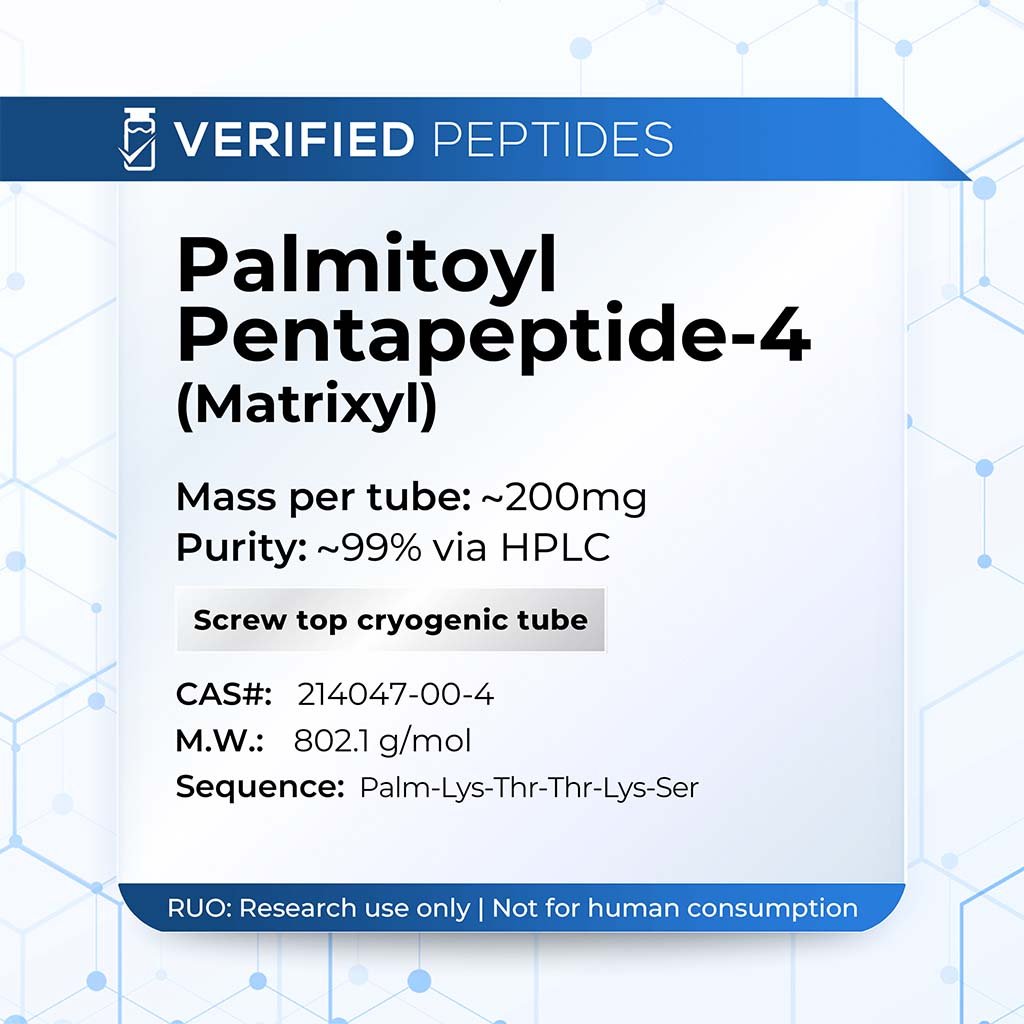
Pal Pentapeptide-4 (Matrixyl) 200MG
$104.00
- Order in the next to get it by October 16, 2026
- Real Time 325 Visitors Right Now
- Spend $500.00 to get Free Shipping
Description
Pal Pentapeptide-4 (Matrixyl) 200MG
Pal Pentapeptide-4, widely recognized in cosmetic science under the Matrixyl name, is a lipidated signal peptide that has become an important subject of research in cosmetic formulation, extracellular-matrix biology and skin-related peptide science.
With its combination of a short peptide sequence and palmitoyl modification, Pal Pentapeptide-4 provides researchers with an interesting model for investigating how peptide structure, lipidation and molecular signaling can influence interactions within skin-related biological systems.
At Peptanovia, Pal Pentapeptide-4 (Matrixyl) 200MG is positioned as a research-grade material for qualified laboratories, cosmetic formulation researchers, peptide scientists and organizations investigating advanced cosmetic ingredients and peptide technologies.
For additional research peptide products and information, explore the Peptanovia homepage.
What Is Pal Pentapeptide-4?
Pal Pentapeptide-4 is a palmitoylated pentapeptide associated with the Matrixyl family of cosmetic peptide ingredients.
The peptide portion is derived from a short sequence associated with extracellular-matrix proteins, while the palmitoyl group provides a lipid component that changes the molecule’s physicochemical characteristics.
This combination is particularly relevant to cosmetic peptide research because researchers can investigate how a lipid-modified peptide behaves differently from a non-lipidated peptide.
Pal Pentapeptide-4 is therefore more than simply a short peptide sequence. Its molecular architecture makes it a useful subject for research involving peptide signaling, skin biology, formulation science and extracellular-matrix processes.
Matrixyl and Cosmetic Peptide Research
Matrixyl is one of the best-known names associated with signal-peptide technology in cosmetic science.
Research surrounding palmitoylated peptides has focused on how these molecules interact with biological pathways associated with the extracellular matrix. This has contributed to the wider development of peptide-based cosmetic formulations.
For researchers, Pal Pentapeptide-4 offers an opportunity to investigate:
- Peptide signaling
- Extracellular-matrix biology
- Collagen-related pathways
- Skin biology
- Cosmetic formulation science
- Peptide structure and activity
- Lipidated peptide behavior
- Ingredient stability
- Topical formulation development
- Comparative peptide research
These applications make Pal Pentapeptide-4 particularly relevant to laboratories and formulation teams working at the intersection of peptide chemistry and cosmetic science.
Pal Pentapeptide-4 (Matrixyl) 200MG Product Details
Product: Pal Pentapeptide-4 (Matrixyl)
Quantity: 200MG
Category: Research peptide / cosmetic research material
Peptide class: Palmitoylated pentapeptide
Research areas: Cosmetic science, extracellular-matrix research, peptide signaling and skin biology
Intended application: Laboratory and formulation research
Form: Verify the specific physical presentation and formulation with the applicable product documentation.
The 200MG designation refers to the quantity supplied. It should not be interpreted as a recommended cosmetic application amount, dosage or therapeutic quantity.
Why Researchers Study Palmitoylated Peptides
Lipidation is an important area of peptide research.
Attaching a lipid component to a peptide can alter characteristics such as hydrophobicity, membrane interactions, formulation behavior and overall molecular properties. This makes lipidated peptides particularly interesting for researchers investigating how chemical modifications influence peptide performance.
Pal Pentapeptide-4 provides a practical research model for examining these relationships.
Researchers can compare lipidated and non-lipidated peptide structures to investigate how molecular modifications may affect experimental behavior.
Pal Pentapeptide-4 and Extracellular-Matrix Research
The extracellular matrix provides structural support for tissues and includes important proteins such as collagen and elastin.
Because peptide signaling has been investigated in relation to extracellular-matrix biology, Pal Pentapeptide-4 has attracted interest within cosmetic ingredient research.
Experimental research can examine how peptide ingredients interact with cellular and molecular pathways associated with extracellular-matrix processes.
This does not mean that every commercial Matrixyl product produces identical biological outcomes. Experimental results can depend on peptide purity, concentration, formulation, delivery system, experimental model and other variables.
Cosmetic Formulation Research
Pal Pentapeptide-4 can also be relevant to researchers developing advanced cosmetic formulations.
Formulation scientists may investigate the peptide in different experimental systems to understand:
- Ingredient compatibility
- Peptide stability
- Formulation pH
- Solubility characteristics
- Preservation systems
- Vehicle compatibility
- Packaging considerations
- Delivery approaches
- Interaction with other cosmetic ingredients
Such research can help formulators determine how peptide ingredients behave within a finished formulation.
Research Grade Pal Pentapeptide-4
For professional peptide research, identity and analytical quality are critical.
Researchers evaluating Pal Pentapeptide-4 should consider documentation covering:
- Peptide identity
- Molecular composition
- Purity specification
- Molecular weight
- Batch or lot number
- HPLC analysis
- Mass spectrometry
- Certificate of Analysis
- Physical appearance
- Storage requirements
- Handling information
- Manufacturing specifications
Lot-specific documentation is particularly useful when reproducibility is important.
Why Purity Matters in Peptide Research
The quality of a research peptide can directly affect the reliability of experimental work.
Uncharacterized impurities may introduce variables that make it difficult to determine whether observed experimental results are associated with the intended peptide or another component.
For this reason, laboratories should review analytical documentation and establish appropriate quality-control procedures before incorporating Pal Pentapeptide-4 into a research workflow.
HPLC can be used to assess chromatographic purity, while mass spectrometry can help confirm molecular identity. Researchers should interpret analytical results according to their own laboratory standards.
Pal Pentapeptide-4 for Cosmetic Science
Cosmetic peptide research has expanded considerably as scientists investigate smaller, more targeted molecules for advanced formulation development.
Pal Pentapeptide-4 is particularly interesting because it combines a short peptide sequence with a palmitoyl group. This provides researchers with an opportunity to investigate both peptide signaling and lipid-modification chemistry within a cosmetic research context.
Potential areas of investigation include:
Peptide chemistry: Understanding the relationship between peptide sequence and molecular properties.
Skin biology: Investigating cellular pathways relevant to skin structure and function.
Extracellular-matrix research: Studying pathways associated with matrix-related proteins.
Formulation science: Evaluating compatibility, stability and delivery within cosmetic systems.
Comparative research: Comparing Pal Pentapeptide-4 with other cosmetic peptides.
Bulk Pal Pentapeptide-4 Supply
For laboratories and cosmetic development companies conducting ongoing research, bulk purchasing can help simplify research-material management.
A bulk Pal Pentapeptide-4 order may be relevant to:
- Cosmetic research laboratories
- Skincare formulation companies
- Biotechnology organizations
- Peptide research laboratories
- Ingredient development teams
- Academic researchers
- Contract research organizations
- Cosmetic R&D departments
- Analytical laboratories
Before purchasing larger quantities, researchers should confirm the required purity, analytical documentation, packaging format and storage conditions.
What to Look for When Purchasing Matrixyl
The name Matrixyl can refer to a family or commercial technology rather than guaranteeing that every product marketed under the name has identical composition or specifications.
For this reason, professional buyers should verify exactly what they are purchasing.
Important considerations include:
- Exact peptide identity
Confirm the chemical identity and peptide sequence. - Palmitoylation
Verify the specific lipid modification associated with the material. - Purity
Review the stated purity and supporting analytical information. - Quantity
Confirm that the product contains the stated 200MG quantity. - Batch documentation
Maintain lot-specific records for research traceability. - Analytical testing
Review available HPLC and mass-spectrometry data. - Storage
Follow the supplier’s recommended storage conditions.
These details are more valuable to professional researchers than relying solely on a product’s commercial name.
Who Uses Pal Pentapeptide-4?
Pal Pentapeptide-4 may be relevant to professionals working in:
- Cosmetic chemistry
- Peptide chemistry
- Molecular biology
- Skin biology
- Formulation development
- Biotechnology
- Cosmetic ingredient research
- Pharmaceutical research
- Academic research
- Analytical science
Its relatively simple peptide structure also makes it useful for comparative studies involving modified and unmodified peptide systems.
Pal Pentapeptide-4 200MG for Research
The 200MG format can be useful for research programs requiring more material than a small analytical sample.
For ongoing projects, researchers may value consistent batch documentation and sufficient material to perform repeated experiments without continually changing suppliers or batches.
As with any research material, the appropriate quantity depends on the experimental design and laboratory requirements.
Research Use and Product Positioning
Pal Pentapeptide-4 is widely associated with cosmetic ingredient research, but research findings should not automatically be interpreted as proof of a clinical or therapeutic effect.
This product should therefore be presented according to its intended research application. It is not a substitute for an approved medicine, and the information provided here should not be interpreted as medical advice or as a claim that the material treats, cures or prevents any disease.
Researchers and formulators should follow applicable regulations, laboratory procedures and product documentation when handling and evaluating the material.
Order Pal Pentapeptide-4 (Matrixyl) 200MG
For researchers exploring Pal Pentapeptide-4, Matrixyl, palmitoylated peptides and cosmetic peptide technologies, the 200MG format provides a practical research quantity for laboratory and formulation projects.
Whether your work involves peptide chemistry, extracellular-matrix research, cosmetic formulation or comparative ingredient studies, product identity and analytical documentation should remain central to the purchasing decision.
Explore additional research peptide materials and product information through the Peptanovia homepage.
Related products
-
 Price$99.00
 -
 Price$99.00
 -
 Price$175.00
 -
Price Original price was: $55.00.$33.00Current price is: $33.00.
Reviews
There are no reviews yet.